-6

Let us consider the following English sentence:

I set the table if you take out the trash.

One doesn't have to set a comma between "table" and "if" – in contrast to the German rules for comma usage: In German, one has to set a comma:

Ich decke den Tisch, wenn du den Müll wegbringst.

In my opinion this obligatory comma disturbs the reading flow. In general, I have the feeling that German requires too many commas which disturb the reading flow. One might argue that in this special case, the comma indicates an intended little pause. But look at this example:

A function is called bijective if it is both injective and surjective.

In German:

Eine Funktion heißt bijektiv, wenn sie sowohl injektiv als auch surjektiv ist.

Here, one usually doesn't make a little pause before "wenn". That's why in this example, the obligatory comma is really useless and disturbs the reading flow. My question is:

Why does the German language, in contrast to the English language, requires so many useless commas which disturb the reading flow?

Be Brave Be Like Ukraine
  • 8,629
  • 9
  • 38
  • 66
ezeze
  • 21
  • 2
  • 9
    English is not standard by which to test if other languages are normal. – Adam Bittlingmayer Jul 01 '16 at 20:41
  • 2
    @A.M.Bittlingmayer: My mother tongue is German. I had to formulate this question in English since this is an English forum, isn't it? – ezeze Jul 01 '16 at 20:44
  • 2
    I have upvoted this question, regardless the fact that the OP uses a totally wrong premise. My reasoning is that the OP (and further readers) can learn from the answer(s), so the question is good enough, – Be Brave Be Like Ukraine Jul 02 '16 at 01:04
  • Sad to see how many thought it was appropriate to downvote the question but then upvoted the selected answer. – Jonathan H Mar 11 '17 at 17:23
  • 1
    @Sheljohn, it's because the question looks like it is "judging" the German language from someone's (subjective) point. However, it is not. I've just edited the title to make it more neutral. – Be Brave Be Like Ukraine Mar 11 '17 at 19:10
  • 1
    'Here, one usually doesn't make a little pause before "wenn".' - I disagree. In my opinion, one does, just as one slightly raises the pitch of one's voice towards the end of "bijektiv", as is usual in front of a comma. – O. R. Mapper Dec 17 '18 at 09:23
  • I agree with @O.R.Mapper. And I'd go a bit further and say that in English pauses (+ other ways of grouping e.g. clauses) are used without marking them by comma. So what? (And to me this is like Polish uses l and ł. Slovenian has these sounds as well, but they always write just l and you have to know which one is meant). – cbeleites unhappy with SX Dec 18 '18 at 16:11

3 Answers3

10

I think your question has a presupposition that is already wrong:

It is not the language, and even less a language's grammar that makes orthography rules.

Orthography is a set of prescriptive, more or less static and sometimes seemingly arbibitrary rules that are about how to transform language into graphemes, but not an inherent part of a language itself.
This is why it doesn't even really make much sense to ask a linguist that question, because linguistics doesn't care about commas.

To still make an attempt to answer your question:
Orthography rules aren't totally useless - how would you use a dictionary or make a Google search if there was absolutely no consensus how to write a word? - and when it comes to arbitrariness and unpredictability, English can be claimed to be significantly worse than German!
The main point is probably that English word order is much more restricted, while German allows for more variance in word order especially between main clauses and subordinate clauses. In speech this can be disambiguated by intonation, while this is obivously not available in written langauge, which is why you make use of punctuation instead.
The rule is that in general, German subordinate clauses need to be separated by a comma, while this doesn't hold true for English. In German it is often more complicated to determine the word order and relationships especially in main clauses because you don't always strictly have SVO (or SOV, which would be the default word order in subordinate clauses) there, and that's one of the reasons German orthography makes more use of commas.
And if the general rule is that every subordinate clause needs to be separated by a comma, then this is in fact easier than making a large list of exceptions for those cases where it seems a little bit more "useless". Everything which is a subordinate clause is put a comma in front of, and this is why this rule totally regularly applies in your example.
In that way, the rule is not as nonsensual.

But again, orthography is not really a concern for linguistics. See this question for some more comments as to why orthography is not an inherent part of natural language itself and therefore not what linguistics traditionally deals with.

Natalie Clarius
  • 6,499
  • 4
  • 21
  • 40
  • @lemontree since I'm here I see a lot from you, good job! – azerafati Jul 02 '16 at 08:36
  • That’s a very narrow-minded definition of linguistics you got there. – Crissov Jul 03 '16 at 10:33
  • @Crissov I'm not very happy with this definition being called "narrow-minded". The scope of linguistics probably depends a lot on where you are. I have a feeling that e.g. philologies tend to be more interested in written language - which makes sense, because orthography is immediately dependant on a specific language, and there must be someone to investigate the interface between spoken and written language/grammar and orthography, after all orthography rules are not completely arbitrary and the guys at Duden certainly know what they are talking about when it comes to linguistic backgrounds. – Natalie Clarius Jul 03 '16 at 11:14
  • But if it's about general linguistics, the tenor in the field I come from is pretty clear that written language is not primarily interesting to a general study of natural language, for the reasons explained in the two comments I linked to. And I understand this site to be about the study of general linguistics - judging from the observation that questions about language-specific questions or translation issues immediately get voted off-topic (actually I'm surprised why no one (including me) voted for this question to be migrated to the German SE, it would probably be better of there). – Natalie Clarius Jul 03 '16 at 11:14
  • So yes of course, writing is somehow related to langauge and there sure are philologists who work pretty intensely on the interface between spoken and written language which is not unreasonable at all, but from a linguistic p.o.v., I have the impression that most people claim written language is not really considered an inherent part of language itself and prescriptive punctuation rules therefore not what a descriptive linguist primarily wants to explain with his theories. – Natalie Clarius Jul 03 '16 at 11:15
  • 1
    @lemontree Written language may have begun at least in part as graphically recorded speech, but it works so differently than and independently from spoken language in a literate culture that it’s a research subject of its own merit in linguistics. Written language has a bad standing among some linguistic schools, because former generations of scholars (especially grammatarians) claimed to study “natural” spoken language, but really only did so by means of written records. Orthographic conventions in general are also not prescriptive rules, though often perceived as such. – Crissov Jul 03 '16 at 14:12
  • @Crissov Having read this post of yours, it seems to me that your main point of criticism is that "former generations" of linguists usually want to account for spoken language while referring to examples in written language. I think this is pretty unavoidable since you can't just put spoken language in a paper (you could use IPA if you want to do it very precise, but that isn't of much avail unless you treat phonology and also is again a form of written language) and doesn't contradict the goal that one wants to account for the language ... – Natalie Clarius Jul 03 '16 at 18:18
  • ... that is spoken rather than how this spoken language is transferred into a literal medium, just because there is no way around choosing the medium of written language to talk about language in papers. The fact that one, trivially, needs to make use of a writing system when writing about language doesn't mean that one wants to focus one's research on that writing system, the written language serves only as an intermediate step to bring spoken langauge into a useable form which can then again be decoded by the adressees back into natural spoken language, ... – Natalie Clarius Jul 03 '16 at 18:18
  • ... meaning the language you have in your mind, but the medium is not automatically the subject of study. – Natalie Clarius Jul 03 '16 at 18:18
1

To complete lemontree's answer, I wanted to add a quote from Mary Norris, "Holy Writ" (The New Yorker):

The comma as we know it was invented by Aldo Manuzio, a printer working in Venice, circa 1500. It was intended to prevent confusion by separating things. In the Greek, komma means “something cut off,” a segment. (Aldo was printing Greek classics during the High Renaissance. The comma was a Renaissance invention.) As the comma proliferated, it started generating confusion. Basically, there are two schools of thought: One plays by ear, using the comma to mark a pause, like dynamics in music; if you were reading aloud, the comma would suggest when to take a breath. The other uses punctuation to clarify the meaning of a sentence by illuminating its underlying structure. Each school believes that the other gets carried away. It can be tense and kind of silly, like the argument among theologians about how many angels can fit on the head of a pin.

It seems that your question assumes that German uses commas to mark pauses, when clearly the last spelling reform seem to focus on their use as a syntactic tool. See also this answer about the differences between English and German punctuation.

Jonathan H
  • 111
  • 3
-2

I will compare German, English and Russian.

  • English has no inflection but strict word order

  • Russian has rich inflection but free word order.

  • German has free word order but poor inflection.

What this means is that in English you use word order to convey some information, in Russian you use inflection, and in German you use punctuation. Russian also does not need a comma here.

Anixx
  • 6,643
  • 1
  • 26
  • 38
  • German has poor inflection? I definitely wouldn't say so. German can be regarded as a fusional language, i.e. the morphemes are not added agglutinatively but instead one grammatical morpheme has various functions which might make it look like it has a tendency towards isolating morphology, but if you take a look at the inflectional paradigms - verbs are fully inflected by person, number, tense and mood, nouns are inflected by three genders, two numbers and four cases, even adjectives are fully inflected just like nouns - I definitely wouldn't say that German has poor infelction! – Natalie Clarius Jul 02 '16 at 10:14
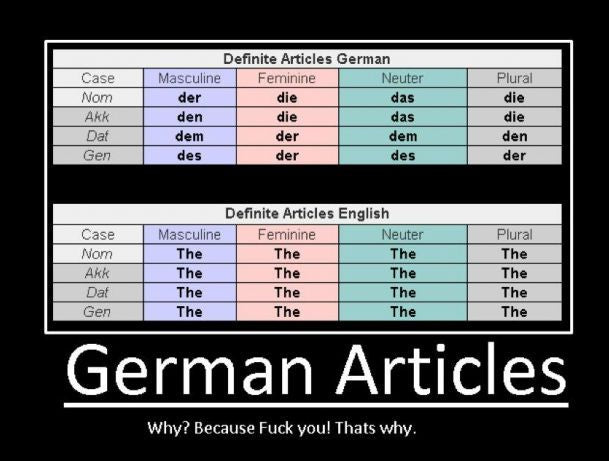
  • I mean, just look at the tables for the various forms of the in German that are used to scare off people ;) (This table isn't even fully correct, because the plural forms differ between the three genders, there is not "the" plural form...) In which aspects would you say that German has poor inflection (it might well be that there are some)? – Natalie Clarius Jul 02 '16 at 10:18
  • Also, "in German you use punctuation" only applies in written language, but language is normally not considered to occur in written, but in spoken form where you can obviously not use commas (at most maybe intonation), so I think that claim is a bit problematic. I would rather say that grammatical information in German is conveyed by inflection too, similarly as in Russian. – Natalie Clarius Jul 02 '16 at 10:22
  • 1
    Anixx’s answer may not be a very good one, but @lemontree’s comments are so full of mistakes that they don’t help to proof that point. – Crissov Jul 03 '16 at 13:35
  • @Crissov It would be nice if you said what exactly all those mistakes are rather than just saying my post is bad and using subjective terms like "narrow-minded". – Natalie Clarius Jul 03 '16 at 13:37
  • 1
    In German, verbs are only partially inflected by person, number, tense and mood. Nouns (and derivational morphemes) carry an inherent gender, but don’t inflect by it (like adjectives and other nominal attributes do). Number and gender form a shared category for the inflection of nominal attributes (incl. der, das, die, die). Overall, there’s a lot of syncretism in inflection paradigms – much more than an isolating morphology would permit. – Crissov Jul 03 '16 at 14:09
  • @Crissov Thanks for the clarification. 1) I agree that verbs are mostly not fully inflected by all the categories mentioned, this was an imprecise formulation of mine. 2) As for the nouns, yes, you could or should say that they carry an inherent gender, meaning that this gender is specified in the noun's lexicon entry, but this doesn't change the fact that those nouns undergo inflection that is indeed dependant on the gender; the choice of, e.g. the accusative form of a noun is (partially) determined by gender and the patterns in the inflectional paradigms of nouns... – Natalie Clarius Jul 03 '16 at 18:28
  • ... are similar to the ones of accompanying adjectives, so I'm not sure it's actually wrong to say that nouns are inflected by gender just because this gender is reprsented already in the lexicon entry, because gender does (amongst others) determine the form of its inflected pedant. 3) Syncretism of forms was exactly the reason I argued that German tends more towards a fusional language - I don't see any contradiction here. – Natalie Clarius Jul 03 '16 at 18:29