11

I recently noticed that most languages have an irregular conjugation for the verb To be. I say almost because I don't know all languages, but the ones I've seen all have some irregularity sooner or later.

Here is a simple table providing some languages from Europe:
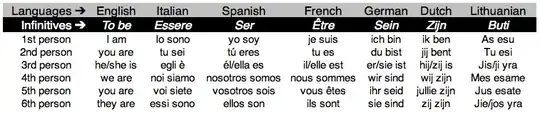
Table representing the conjugation for the verb to be in many languages.
Note: if you find mistakes, let me know.

So far, I found only one language that fulfills the requirement, Quechua, with the verb "Kay":

1st — Ñoqa ka-ni
2nd — Qam ka-nki
3rd — Pay ka-n
1st — Ñoqanchik ka-nchik — inclusive
1st — Ñoqayku ka-niku — exclusive
2nd — Qamkuna ka-nkichik
3rd — Paykuna ka-nku

As you can see, the root (which is "ka-"), is always present. Excluding the ones from the list below, are there other natural languages that have the verb "to be" (meaning existence, not location) but regular?

  • Asian languages
  • Swedish/Norwegian/Danish
  • All of the languages that have the same form for all the persons
  • Languages that don't use this verb in the Present Affirmative form, e.g. Russian
Alenanno
  • 9,388
  • 5
  • 48
  • 80
  • 3
    Many languages don't have a word that means what English to be does. It's highly irregular in English and other PIE languages (all the ones you cite are PIE) because it's used so often as an auxiliary). Languages like Malay or Russian don't use auxiliary be for progressive, or predicate adjectives, or predicate nouns, or passive, so the question is which verb be you're asking about. Ser or estar, for instance? Exist or be located? – jlawler Feb 07 '12 at 00:20
  • 1
    @jlawler just a guess from his example, probably the ser variant.. But I agree, many languages doesn't even have a verb for this concept – Louis Rhys Feb 07 '12 at 00:48
  • 4
    Esperanto, but maybe you were looking for natural languages? :) – Mark Beadles Feb 07 '12 at 01:58
  • @jlawler The verb for "existence". By the way, I'm aware that some verbs don't even have it, that's why I didn't include Russian in the first place. I'm looking for those who have it, obviously, but maybe I should have specified that. – Alenanno Feb 07 '12 at 10:04
  • @MarkBeadles Yes yes, only natural... Constructed languages are off topic here :) — @ everyone: I updated the question for clarity. – Alenanno Feb 07 '12 at 10:07
  • And of course other languages have more than one copula, such as Spanish and Georgian and Japanese. – hippietrail Feb 08 '12 at 09:20
  • 2
    Wouldn't it be more natural to look at copula instead of "existence" (as these are not necessarily the same)? – dainichi May 15 '12 at 01:05
  • 1
    @dainichi: Further, "be" doesn't normally even mean existence (outside of literary usage). – Mechanical snail May 28 '12 at 04:53
  • Would languages with invariant copulas stand among the languages that you're looking for? I'm thinking of Mandarin. – James Grossmann Jul 07 '12 at 21:27
  • You do not need to include 3 Romance languages in this table because it was already irregular in Latin. Also who told you this idiotic idea that Russian has no "to be"? Infinitive: быть, 1st 2nd, 3rd person, both sg. and plural: есть. – Anixx Dec 30 '12 at 13:23
  • @Anixx I wanted to include them. The russian verb быть is not currently used as the verb To be. You say Я студент and there is no "to be" verb there. It's either used to form the past, the future or the negative. In the present affirmative form it's absent. – Alenanno Dec 30 '12 at 13:25
  • @Alenanno it's absent because the verb is not needed in that sentence, not because быть does not mean "to be". It is a peculiar feature of English language that it requires "to be" in every sentence. – Anixx Dec 30 '12 at 13:39
  • @Anixx Any language I know would have "to be" in that sentence. There is no peculiar feature here, and if there is one, Russian has it. – Alenanno Dec 30 '12 at 13:44
  • @Alenanno Lithuanian also does not require "to be" everywhere. Find me a single instance of singular "to be" verb in this Wikipedia article: http://lt.wikipedia.org/wiki/Monomotapa I only found three instances for plural. A corresponding Russian article uses plural "to be" twice. – Anixx Dec 30 '12 at 13:46
  • @Anixx We're not talking about everywhere. I was talking about a standard sentence. And Lithuanian does use the verb to be in the sentence "I am a student" = Aš esu studentas. – Alenanno Dec 30 '12 at 13:53
  • @Alenanno no it is more likely omitted or replaces with a dash. Visiuomeniniame transporte stovi distrofikas. Sėdinti senolė klausia:
    • Kodėl toks kūdas?
    • Aš studentas.
    • Tai gal labai daug mokaisi?
    • Ne. Vidutiniškai.
    • Tai gal atsisėt nori?
    • Ne. Pastovėsiu.
    • Tai duok lietpaltį palaikysiu.
    • Čia ne lietpaltis, čia mūsų pirmūnas. http://www.anekdotai24.lt/anekdotai/distrofikas-studentas/ ; also http://ieskaukambarioko.lt/-%20Labas.%20A%C5%A1%20studentas.%20Ie%C5%A1kau%20stogo%20prisiglausti,.html
    – Anixx Dec 30 '12 at 14:02

9 Answers9

6

The Turkish copula olmak is meant to be regular.

Wiktionary's conjugation table for the Turkish verb olmak

Alenanno
  • 9,388
  • 5
  • 48
  • 80
jogloran
  • 5,145
  • 28
  • 47
  • 1
    for what it's worth I added a link to a conjugation table by wiktionary. I don't know if it's correct or not, but they do use an automated template to fill that. So if it's correct, it must be regular – Louis Rhys Feb 07 '12 at 02:11
  • jogloran, thanks, do you mind adding the conjugation for the affirmative? You can use the template I used in my question for Quechua. :) – Alenanno Feb 07 '12 at 10:22
  • 1
    I'm far from being a native speaker of Turkish, but my understanding is that "to be" has enclitic forms that replace the full verb olmak in some (most?) aspecto-temporal contexts. So, contrary to what one might think after looking at that conjugation table, "I'm a student" translates to "Öğrenciyim" and not "Öğrenci olurum." But I don't know whether this "-(y)im" morpheme (and its cousins) can be considered as forms of olmak. (My teacher says so, but she's no linguist, "just" a native speaker.) If this morpheme is to be counted as a form of olmak, that would be a strong irregularity. – JPP Feb 13 '12 at 21:10
  • JPP made a valid point. olmak can, to a certain degree, mean 'to be' but its primary meaning is 'to become', while copula is primarily expressed by predicative suffixes. JPP's teacher might consider them to be different forms of one thing because of the semantics and their function but linguistically speaking, they are totally separate beasts. Let me know if you need a fuller explanation. – kamil-s Feb 28 '12 at 11:32
  • Thanks, Kamil. Maybe my teacher presents them as different forms of one thing on pedagogical grounds, because to us, they are just translations of the verb « être. » But she has no training in linguistics (and, as far as I can tell, no interest in byzantine grammatical distinctions), so I guess her personal vision on the matter is quite close the grammar taught in Turkish schools. – JPP Feb 28 '12 at 18:11
  • @JPP I'll admit I don't know how grammar is taught in Turkish schools. I wonder, if you went out in the street and asked ten people whether être and suis or vais and allé are different forms of one verb, what would the majority of answers be? For parallel cases in Polish, I'm quite confident most people would say they're one thing. So, precious as native speaker's evidence generally is, in this particular case I suggest we better not take it into consideration :) – kamil-s Feb 28 '12 at 18:23
  • @jogloran, have you seen my comment? – Alenanno Mar 06 '12 at 18:42
6

Tibeto-Burman languages are an interesting example of copula verbs that are 'regular' across all person and number forms. I'll share an example from Lamjung Yolmo, because that's what I am documenting at the moment, but you can find similar things in Sherpa, Lhasa Tibetan and other languages of this family.

In Yolmo there are actually a number of copula verbs, all of which can be used regardless of person or number, but that's because they're marking something other than tense or aspect. I'll just highlight the difference between two of them.

There is which is used where an English copula is used for "X be adjective" where X is any person number. This can be contrasted with which can also be used for "X be adjective" constructions. The difference is nothing to do with person, but an evidential distinction, with being used for information that someone already knows to be true and being used for information that the person has recent direct perception of. So in the case of "she is tall" if I saw her every day I'd use but if I walked down the street and saw someone who was tall I might point them out and use .

Obviously, certain persons go with certain constructions - it's unusual to use direct perception for yourself because you already know what you're doing without evidence. But there are cases where it's appropriate to use it, so it's not a true person distinction.

So the take-home message from that is that not all of the world's languages require the copula verb to mark person and/or number, making it perfectly easy to have a regular form and no need for conjugation.

LaurenG
  • 3,127
  • 1
  • 21
  • 34
4

Kiswahili might be a candidate. There are a few different verbs that correspond to English 'to be'; kuwa 'be, become' is regarded as the main equivalent as far as "existence". It is also used for "to have" in conjunction with na (i.e., kuwa na='to be with"='to have") And also, Kiswahili has a negative conjungation, so 'to not be' and 'to be' are different conjugations. So exact equivalency, as noted above, is tough.

But to the point here: for kuwa the "exist" verb, the present tense forms are identically ni in the modern language; and for the other tenses the forms are regularly conjugated off the root -wa.

I am ni
You are ni
He/she/it is ni
We are ni
You are ni
They are ni

I was nilikuwa
You were ulikuwa
He/she/it was alikuwa
We are tulikuwa
You are mlikuwa
They are walikuwa

I will be nitakuwa
You will be utakuwa
He/she/it will be atakuwa
We will be tutakuwa
You will be mtakuwa
They will be watakuwa

However I am not an expert in Swahili so it may be that I am missing some suppletive form in a strange tense or something. EDIT: See also this nice handout.

Mark Beadles
  • 6,860
  • 2
  • 24
  • 46
2

Yes. In Danish 'be' is realized as < er > and in Swedish it's realized as < är > for all persons and numbers. I am not sure what the exact phonological realizations of these are, sorry. These languages have no agreement, so the paradigms for 'be' are completely regular.

Source: the Penn textbook (all available for free online) for introductory syntax, Chapter 6.

  • 1
    I'd exclude that as there is no conjugation (see edits to my question). The Quechua one conjugates, but still it's regular. I've added Danish to complete the list. :) – Alenanno Feb 06 '12 at 22:30
  • Ah, sorry. Didn't see that! :) –  Feb 06 '12 at 22:32
  • Don't worry! :D – Alenanno Feb 06 '12 at 22:33
  • 4
    But a different root is used for past tense: "var" – kaleissin Feb 07 '12 at 10:36
  • 1
    You definitely need to take all forms into account to decide whether a verb is regular, and that means tenses! – hippietrail Feb 08 '12 at 09:21
  • 2
    It depends on what your mean by regular. If a stem is suppletive, but still regularly conjugated for any particular tense, you could consider that regular, or not. –  Feb 08 '12 at 16:10
  • That doesn't make sense... So just because a stem is suppletive in some tenses, the verb can have irregularities between other tenses and still be regular? Even if 'er' is considered regular, 'var' is still irregular, since it is the same stem as the infinitive 'være' and thus should be 'værede' or 'værte' (with the definition of 'regular' for Danish verbs that I know of). – dainichi May 15 '12 at 01:03
1

Lakota Sioux “úŋ” is completely regular.

I am = waúŋ You are = naúŋ He/she/it is = úŋ

You and I are = uŋk’úŋ

We are = uŋk’úŋpi y'all are = naúŋpi they are = úŋpi

Though, they tend not to use it except for (rare) emphatic purposes.

MAMaK
  • 11
  • 1
0

In Q'eqchi' the verb wank (both existence and location) is completely regular: wankin, wankat, wank, wanko, wankex, wankeb'. Same for future (twanq) and past (xwank).

In Q'eqchi' the construction be + predicative noun (quality) is also 100% regular: to be angry: josq'in, josq'at, josq', josq'o, josq'ex, josq'eb'

Hyperboreus
  • 133
  • 5
0

The Afrikaans language does not conjugate verbs. Even converting into past participles results in very very few irregular ones, which are no foreign to us. e.g.: Ek is, Ek was (I am, I was).

That is probably you will never find a book called "501 fully conjugated verbs in Afrikaans" coz the verbs do not change at all.

0

The existential copula in Malay "ada" remains unchanged in all sentences because of the analytical nature of the language, as well as the lack of agreement and morphological tense in the language.

Ada seekor burung           Ada 3 ekor burung
COP one.CL    bird          COP 3 CL   bird
There is a bird             There are 3 birds

Ada seekor burung semalam   Ada seekor burung esok
COP one.CL bird   yesterday COP one.CL bird   tomorrow
There was a bird yesterday  There will be a bird tomorrow

Ada seorang perempuan       Ada seorang lelaki
COP one.CL  girl            COP one.CL  boy
There is a girl             There is a boy

There is also the use of the existential verb "terdapat" in place of "ada". It's used mostly for the purpose of formality as "ada" is regarded as being less formal. "Terdapat" doesn't have the copular properties of "ada" and is comprised of the non-volitional suffix 'ter-' and the deontic modal/verb "dapat" (can/to get). "Terdapat" can only be used as an existential verb with the non-volitional suffix. Without it, it would mean "to get".

Dapat seekor burung!        Dapat tangkap seekor burung!
Get   one.CL bird           Could catch   one.CL bird
(I) got a bird!             (I) could/got to catch a bird!

"Terdapat" also remains unchanged in all of the sentences above.

Morphosyntax
  • 1,582
  • 11
  • 20
0

Hawaiian has no word for "to be", instead using adjectives and nouns as verbs representing existance (i.e. "I am smart" is just "I smart"). However, if their were a verb for "to be" it would probably be regular, since every other verb is.