15

I originally posted this a while ago on my blog, but someone recently suggested that I pose it as a question here.

A brief Wikipedia search on the origin of the word ‘god’ reveals the following:

The earliest written form of the Germanic word god comes from the 6th century Christian Codex Argenteus. The English word itself is derived from the Proto-Germanic * ǥuđan. Most linguists agree that the reconstructed Proto-Indo-European form * ǵhu-tó-m was based on the root * ǵhau(ə)-, which meant either ‘to call’ or ‘to invoke’.

Google came up with this link which presents a survey of various sources that attempt to decipher the origin of the word. It begins with a short summary of its conclusion, which contains the following sentence:

The word God is a relatively new European invention, which was never used in any of the ancient Judaeo-Christian scripture manuscripts that were written in Hebrew, Aramaic, Greek or Latin.

I am befuddled by the fact that they seem to have overlooked a very clear source.

In Genesis 30:11 - we read:

וַתֹּאמֶר לֵאָה בגד \ בָּא גָד

And Leah said, "gad has come."

Targum [Pseudo-]Jonathan interprets:

וַאֲמַרַת לֵאָה אָתָא מַזְלָא טָבָא

And Leah said, "the good 'mazal' (astrological sign / luck) has come."

I would assume that if ‘mazal’ = ‘gad’ then we could have a pretty good indication of where the word ‘god’ came from.

If this isn’t good enough, note the word גדא which is mentioned several times in the Talmud. See, for example, Hullin 40a:

אמר אביי לא קשיא הא דאמר להר הא דאמר לגדא דהר דיקא נמי דקתני דומיא דמיכאל שר הגדול

...Abbaye said, "it is not problematic, for this is when he said [he was slaughtering it] for the mountain and this is where he said it was for the gada (referring some heavenly minister that some would serve as a god) of the mountain...

It is quite clear from the context that גדא דהר means just that; god of the mountain!

Does anyone have any knowledge that would help in figuring out whether or not these words (גד and god) are actually related, as they seem to be?

hippietrail
  • 14,687
  • 7
  • 61
  • 146
Dov F
  • 299
  • 1
  • 2
  • 6
  • 3
    The answers below seem to conclude that this is a coincidence. I'll just add that the word is quite short and simple, and the significance you ascribe to the match would have been more likely had the word contained 7 or 8 syllables. – Double AA Aug 03 '12 at 06:53
  • 1
    It's very rare to have 7 syllables; perhaps you meant 7 phonemes? I have always been interested in the Abraham/Brahman connection but it's very hard to find anything scholarly on the matter in the midst of the morass of ecstatics online jumping on it. – Daniel Briggs Nov 02 '12 at 01:11
  • 3
    Although the answers that preceded me seem to conclude that "God" is not related to גד, it's interesting to note that Rabbi Yaakov Tzvi Mecklenburg (in his commentary to Genesis 1:1, in the end of his discussion of the word "א-להים") does say that "God" is connected to "גד." – b a Nov 01 '12 at 01:42
  • 2
    The uses of "gad" in this is all simply wrong; "gad" means goat. As for the Targum Jonathan here, the astrological sign Cancer is represented by a goat. "Gada d'har" would mean "mountain goat". – PixelArtDragon Apr 18 '14 at 15:23
  • Whether gad also means goat does not change the point. The point is that the word refers to a power that was worshiped, as is clear from passages in the Talmud such as the one cited, as well as Isaiah 65:11 הַעֹרְכִים לַגַּד שֻׁלְחָן. Cancer being the sign of the goat only amplifies this point. – Dov F May 04 '14 at 02:45
  • I distinctly rember reading somewhere that IE roots of 'good' and 'God' are same. – ARi Apr 29 '17 at 12:14

2 Answers2

19

Hebrew is an Afro-Asiatic language, whereas Proto-Germanic is an Indo-European language.

Both superethnic and cultural groups (Afro-Asiatics and Indo-Europeans) were connected through the history of trade, migrations, and the written alphabet. Afro-Asiatic cultures had trade routes throughout the Middle East, Orient, and Asia; and Indo-European cultures had both migratory and trade routes throughout the Orient, the Middle East and Europe; both groups shared these routes for thousands of years. The first written alphabet was Phoenician (Afro-Asiatic), and it was used as a model for the development of the Indo-European alphabets.

But we don't know of any relation between these two language families: they seemed entirely unrelated even in our earliest sources. If there is any relation, it is shrouded in the mists of remote prehistory (although some people hypothesise a prehistoric relation). Barring very strong evidence to the contrary, any similarity between a Hebrew word and a Germanic word must therefore be ascribed to coincidence.

had trade route interactions with Afro-Asiatic cultures for thousands of years

There are two theories about the origin of the Germanic word, which is still uncertain:

  1. It could be from Proto-Indo-European *ghau- "call, invoke", as the entity that is invoked;

  2. Or it could come from Proto-Indo-European *gheu- "pour", as the entity to which libations are offered.

Do you have any information about the origin of the Hebrew word?

Cerberus
  • 7,976
  • 33
  • 49
  • Thank you. I don't have more info on the Hebrew word's origin, but don't you think this is quite the coincidence? גד is pronounced virtually the same as god, and has been used (even biblically, according to Talmud Shabbat 67b - HT HodOfHod) to signify a spiritual power one would worship. Is it really likely that they aren't related? – Dov F Jul 10 '12 at 17:32
  • 9
    @DovF Historical linguistics works by establishing systematic sound correspondences. One word is just not enough for this and may very well be a coincidence. – Otavio Macedo Jul 10 '12 at 17:59
  • 8
    @DovF: You would be amazed at the many striking coincidences that exist in linguistics, especially etymology! So, yes, I strongly expect this to be coincidental. If you look up the etymology of the Hebrew words, I believe that will shed some light upon the coincidence (or connection...). Unfortunately, I can't read Hebrew. Could you look the word up for me and give me a translation of what this etymological dictionary has to say about the etymology of גד? http://www.hebrewetymology.com/ – Cerberus Jul 10 '12 at 20:27
  • @Cerberus I'm not really sure how this dictionary works, but the end of the paragraph on גד connects it to the English 'good' and to two Russian words that appear to mean flowing and fortune-telling, respectively. – Dov F Jul 10 '12 at 20:40
  • 1
    @DovF: Huh, okay, perhaps that dictionary wasn't very useful? I was hoping it would lead to proto-Semitic roots, like Indo-European dictionaries. If I look at the information that Alex has found below, it seems it is related to something like good luck, while the Proto-Indo-European roots are related either to pouring or to calling. As you say, going back in times only makes the meanings of the Hebrew and German words grow apart, not come closer; if they had had a common origin, they would have come closer. So I think we may conclude that the observed later similarity in meaning and sound is.. – Cerberus Jul 11 '12 at 04:49
  • 1
    ...coincidental. It is theoretically possible that there was some later influence of the Hebrew word on the Germanic word in the early Middle Ages: because the two words sounded somewhat similar, and their meanings were vaguely similar, the meaning of the Hebrew word might have pulled the meaning of the Germanic word a bit in the same direction. However, since etymology is based on phonology, regular changes from one sound into another within a language, this influence would have broken the normal regularity of etymological development. That can happen, but then the German etymological ... – Cerberus Jul 11 '12 at 04:52
  • 1
    ... dictionaries that I consulted (Kluge and Duden) should have noticed and remarked on this irregularity; however, they do not. Then all our information seems to point into the same direction: coincidence. – Cerberus Jul 11 '12 at 04:54
  • 1
    @Cerberus I think I understand your point. Thank you. – Dov F Jul 11 '12 at 10:18
  • 3
    @Cerberus Just for your information, that dictionary you linked isn't an actual etymological dictionary. It's one of many different mystic attempts to place Hebrew at the root of all languages. That becomes more clear if you look at the (English) introduction, which claims Hebrew has no roots in any other language and each Hebrew letter represents one of seven primal concepts that are combined to create meaning. As Alex B remarked below, a real etymological dictionary will ultimately trace it back to Proto-Semitic gadd-/gād-. – voikya Jul 15 '12 at 07:24
  • @voikya: Oh dear, haha. I shouldn't have posted a link to a source I couldn't read. I hoped the first Google hit for "Hebrew etymological dictionary" would be a respectable source, but alas. – Cerberus Jul 15 '12 at 09:09
  • 2
    By the way, Dov, for me, as in many parts of the English-speaking world, "God" and "Gad" have completely different vowels and certainly not "pronounced virtually the same". – Colin Fine Jul 23 '12 at 22:38
  • 1
    @Cerberus: Your answer makes it look like there should be no Afro-Asiatic Hebrew words in English at all, but of course there are such words due to borrowing. I would think that to completely rule out a relationship, at least to the OP's satisfaction, you would also need to address issues of the timeframe of known borrowings. – hippietrail Nov 01 '12 at 16:34
  • @Cerberus: Now that I've read all the comments I see you've addressed it there - but I feel the answer would be improved by including something of it anyway. – hippietrail Nov 01 '12 at 16:42
  • @hippietrail: Feel free to edit my answer! – Cerberus Nov 01 '12 at 23:54
  • @Cerberus: I would if I felt knowledgeable in this area (-: – hippietrail Nov 02 '12 at 02:50
  • 2
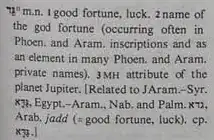
    @Cerberus I realize this is an old discussion, but you wanted it looked up in a Hebrew entomological dictionary, so: masculine noun, 1) good fortune, luck. 2) name of the god fortune (occurring often in Phoenician and Aramaic inscriptions and as an element in many Phoen. and Aram. private names), related to JAram/Syriac "gadda", Nabatean and Palmyrene "gada", Arabic "jadd" – Mike Jun 29 '14 at 21:13
  • @Mike: Ah, cool! That seems to be the same source Alex used in his answer below. His screenshot also notes "3 MH attribute of the planet Jupiter". It is quite interesting that the Romans also used Jupiter for the king of the gods and for the planet. But that is probably a later association in Hebre, or not? What does "MH" mean? Middle Hebrew? – Cerberus Jun 30 '14 at 00:14
  • MH is Modern Hebrew, which is why I didn't quote that part of the definition. The dictionary is A Comprehensive Etymological Dictionary of the Hebrew Language for Readers of English. I did not see Alex's screenshot until just now. – Mike Jun 30 '14 at 01:11
13

Theological issues aside, I can see several wrong assumptions in your question.

"The word God is a relatively new European invention, which was never used in any of the ancient Judaeo-Christian scripture manuscripts that were written in Hebrew, Aramaic, Greek or Latin."

It's not entirely clear what you meant there. If you are talking about the English word "god", then why would you expect to come across an English word in a Latin or Greek text? If you are talking about the concept of "god(s)", then your assumption is inaccurate. It is a well-known fact that various Indo-European peoples had gods, attested by names of deities (Jupiter, Zeus, Perkunas etc.) and the word 'god', e.g. Latin 'deus', Vedic 'devas' etc. As a matter of fact, Father Sky is a very common deity in many IE cultures. A common motif is the main god fighting/killing some chthonic creature (a snake or a dragon).

Now about "Gad" and English "god". The wrong assumption here is what Yuri Otkupschikov called "chronological scissors" (chronological disparity). You are comparing words that don't belong to the same time period. Yes, in OE the word was "god" but looking at other Germanic languages you can't help but notice that originally the root vowel was not "o" but rather "u", e.g. have a look at this.

I'm not a Hebraist (nor a Semitologist) but here's what I've been able to find about the origin of the Hebrew proper noun "Gad". I strongly recommend looking it up at least in Klein 1987:

enter image description here

A general remark on etymology:

"A generally accepted principle (advocated by Meillet) permits only comparisons which involve both sound and meaning together. Similarities in sound alone (for example, the presence of tonal systems in compared languages) or in meaning alone (for example, grammatical gender in the languages compared) are not reliable, since they often develop independently of genetic relationship, due to diffusion, accident and typological tendencies" (Campbell 2004: 356, emphasis mine - Alex B.)

Executive summary: I am very skeptical of your hypothesis/evidence and my answer is no.

Alex B.
  • 8,744
  • 2
  • 25
  • 42
  • 1
    The sentence you quote is not mine, it is a quote that I expressed confusion over. All I am dealing with is the word, not the concept. As for pronunciation - it isn't clear to me that the [only] correct pronunciation of the Hebrew word is gad. In fact current Ashkenazi pronunciation of the word is guhd. – Dov F Jul 10 '12 at 18:32
  • 2
    Chronological disparity: Hebrew "Gad", OE "god", and current Ashkenazi Hebrew "guhd". – Alex B. Jul 10 '12 at 18:55
  • Current Ashkenazi pronunciation (at least this aspect of it) is quite possibly several thousand years old. – Dov F Jul 10 '12 at 20:24
  • I don't know what you are trying to prove from Campbell. That is exactly what I did - this is a similarity both in sound and in meaning. – Dov F Jul 10 '12 at 20:26
  • @DovF, 1. Hebrew "Gad" does not mean "god". 2. "Current Ashkenazi pronunciation is possibly several thousand years old." Evidence? References? – Alex B. Jul 10 '12 at 21:14
  • And, most importantly, why do we even need Yiddish evidence here? Yiddish is usually considered to be a Germanic language. – Alex B. Jul 10 '12 at 21:57
  • I'm lost. You seem to be ignoring my points. I've never said anything about Yiddish. – Dov F Jul 10 '12 at 22:46
  • Ok, let's take one step at a time. 1. What does the Hebrew "gd" (Gad) mean? – Alex B. Jul 10 '12 at 22:58
  • It could mean luck, or a god (not in the monotheistic sense, but in the sense of a superhuman being that asserts some power, like Zeus or Jupiter). – Dov F Jul 11 '12 at 01:17
  • @DovF, logically, it could be 1. a common noun meaning "luck"; 2. a proper noun derived from (1) - personification; 3. a proper noun of some other origin. Nowhere do I see evidence that it means "god". If you claim that "gd" means "god" in Hebrew, you need to give us evidence. – Alex B. Jul 11 '12 at 03:48
  • 1
    Isaiah 65:11 "But as for you who forsake the Lord and forget my holy mountain, who spread a table for Fortune (גד) and fill bowls of mixed wine for Destiny" - NIV. Fortune is capitalized as it refers to 'the god of fortune.' This is the Talmud's translation of the verse as well. Once you get to Aramaic it already means any kind of God - I showed that in my question. But yes, that passage is much more recent (300 or so AD). – Dov F Jul 11 '12 at 10:11
  • Looking at your edit I see that Klein actually says that it can mean the name of the god fortune. – Dov F Jul 11 '12 at 10:16
  • 1
    @DovF, ok, now we have "gd" in Hebrew meaning "Fortune" (like Latin Fortuna). Ignoring relatively unimportant things here, a real challenge to you is to explain when, how, and why the ancient Germans might have borrowed this word from who by the way? – Alex B. Jul 11 '12 at 15:28
  • How old is the proto-Germanic ǥuđan? Is it possible that it was picked up from Roman Christians or something? – Dov F Jul 11 '12 at 15:46
  • 2
    @DovF, I see. So you want me to do all the work for you.

    Since “god” is a pan-Germanic isogloss (present in most, if not all, Germanic languages, in the same form), then this putative borrowing must have happened before the Germanic languages split into two groups (“from approximately 2500 B.C. to the beginning of our era”).

    Now about the putative borrowing via Latin (?), since you didn’t specify the possible “intermediary” language. If it was indeed the case, you should easily find traces of the Hebrew “gd” in Latin or whatever language you propose for Roman Christians. Any evidence?

    – Alex B. Jul 11 '12 at 16:37
  • 2
    The only possibility that I could see was that perhaps this is an exceptional case of where a combination of sound + meaning survived from the common ancestors of the Afro-Asiatic and Indo-European proto-languages: some linguists hypothesise a common proto-language called "Nostratic". That would still be extreme speculation. But then one would expect the meanings and sounds to converge as one goes back in time to known proto-roots, which is not the case. Further, since the proposed Urheimats of PAA and PIE are far apart, and PAA is perhaps 10,000 years older, a link seems all but impossible. – Cerberus Jul 11 '12 at 16:58
  • 4
    And, of course, Grimm's law is looming ... – Alex B. Jul 11 '12 at 16:58
  • I see. It appears that the consensus here is that there is very little evidence to support a relationship between gad and god. I guess I'll accept that. @AlexB. I apologize for 'expecting you to do all the work.' I'm just a complete amateur in this field and don't really know where to start. I do appreciate all the helpful input you've provided. (And as for the intermediary language, I was not assuming there was one, since I figured they had plenty of Hebrew speakers in the early days.) – Dov F Jul 11 '12 at 17:40
  • 2
    @DovF, I was trying to guide you in your quest, so to say. You should read Philip Durkin's book, The Oxford guide to etymology. It's a good place to start. Good luck! – Alex B. Jul 11 '12 at 17:47
  • 1
    @AlexB. Thanks, I'll put that at the top of my list. – Dov F Jul 11 '12 at 18:08
  • 3
    I know of one respectable scholar (Theo Veenemann) who argues for a number of borrowings into Germanic (specifically) from Semitic (the root of "earth" is one of his examples). But his theory has few proponents, and of course at the time depth he is not suggesting that the source is any semitic language that we have specific knowledge of. – Colin Fine Jul 23 '12 at 22:44
  • 1
    In fact exactly one year ago we had a question on this very topic: Was there a Semitic influence on Proto-Germanic? – hippietrail Nov 01 '12 at 16:56
  • 1
    Since the first evidence of Germanic is in Christian scripture, there can be no doubt about Semitic influence, however indirect. That's not anachronistic. Semitic influence, however indirect, on Proto Germanic, is a big question, if the origin of Germanic is still uncertain, and often assumed to have happened in isolation. – vectory Jun 27 '19 at 04:51
  • Interestingly enough, there are many cognates between names for Greek and Roman gods and entities in Hinduism, such as Uranus/Varuna. Some concepts in the religions, such as respect for religious plurality and acceptance of "foreign" gods as legit or at least acceptable, are also shared. This is because there is a common souce - Proto-Indo-European religion. Semitic-speaking peoples had a separate religious system which was later adopted by Indo-European-speaking peoples in the forms of Christianity (Romans, Celts, Vikings, etc.) and Islam (Persians, Kurds, Albanians, Indian Muslims, etc.). – Robert Columbia Oct 16 '19 at 16:44