8

Does any body know how old-Persian numeral were used and provide some example?
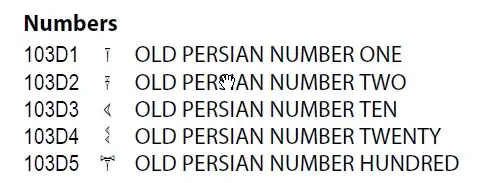
enter image description here

(source of image is Unicode characters maps)

Real Dreams
  • 725
  • 4
  • 18
  • Your question seems a little too broad... :) The answerer would need to make a research for each of these (unless there is a common resource, but I doubt that). – Alenanno Nov 25 '12 at 14:42
  • I was going to point you at Daniels & Bright, The World's Writing Systems, but I find that though it covers scripts of those names, it doesn't have anything on numerical notation for them. – Colin Fine Nov 25 '12 at 16:29
  • Are you interested in the ideographs (how they were written) or how they were pronounced? – Alex B. Nov 25 '12 at 20:57
  • As something to start with (on Old Persian), pp. 256-258, also Table 7.17 and Figure 7.2 in Chrisomalis, Stephen. 2010. Numerical notation: A comparative history. Cambridge: CUP. http://www.cambridge.org/us/knowledge/isbn/item2709599/?site_locale=en_US – Alex B. Nov 25 '12 at 21:09
  • @AlexB. I am interested in how these is used in counting. For example how to write 453 is theses number – Real Dreams Nov 26 '12 at 06:43
  • @AlexB. Thanks to reference, currently I do not have access to that book, but I will investigate on it as soon as possible – Real Dreams Nov 26 '12 at 06:51
  • Old Persian numerals were treated somewhat like Roman numerals: they were based on juxtaposition, and not place-value; unlike Roman they were right-to-left. So "5" was 2 2 1 and "18" was 10 2 2 2 2. Decimal 453 would have been 100 100 100 100 20 20 20 10 2 1. See http://sites.la.utexas.edu/persian_online_resources/history-of-the-language/old-persian-script/ I have no idea about the other scripts. – Mark Beadles Nov 26 '12 at 21:08
  • @MarkBeadles Thanks, How you define direction for numerals? Direction of Old Persian Numerals are Like Arabic numerals. I think Arabic and Old-Persian numerals are both from left to right, and roman numerals are almost left to right, 4,5,6 -> IV, V, VI, indeed if while righting a number you place most value number in left it starts on the left and so it right to left – Real Dreams Nov 27 '12 at 04:52
  • @MarkBeadles "5" was 2 2 1 in Roman? Wasn't 5 simply V? – Alenanno Nov 27 '12 at 10:39
  • 1
    @Alenanno "somewhat like" Roman, but not identical. The numerals I listed work for Old Persian. Yes, Roman had symbols for 5, 50, 500 instead of 2, 20 – Mark Beadles Nov 27 '12 at 13:10
  • @Reza Yes, I put that badly. I should say that unlike Roman, the numerals were always place in a single direction. You're right, it's ambiguous to call it right-to-left :) Perhaps largest-value-on-the-left. – Mark Beadles Nov 27 '12 at 14:20

1 Answers1

5

Old Persian numerals were treated somewhat like Roman numerals: they were based on juxtaposition or addition[PDF], and not place-value [PDF] like Arabic, Mayan, or Bablylonian numerals

Unlike Roman, the numerals were always placed in a single direction (largest-value-on-the-left); there was no subtractive notation like IV for 4. Also, Roman had symbols for 5 (V), 50 (L), 500 (D) instead of 2, 20.

So n Old Persian, "5" was 2 2 1 and "18" was 10 2 2 2 2. Decimal 453 would have been 100 100 100 100 20 20 10 2 1.

Real Dreams
  • 725
  • 4
  • 18
Mark Beadles
  • 6,860
  • 2
  • 24
  • 46