3

Are there any resources that can show IPA pronounciation for each PIE word? Either with laryngeals or without laryngeals?

Wikitionary gives me only small list Category:Proto-Indo-European terms with IPA pronunciation, where:

*bʰréh₂tēr is [b̤ráx.tɛːr], *h₂éwis is [xáwis], *méh₂tēr is [máx.tɛːr], *nisdós is [niz.dós], and *pénkʷe is pronounced [péŋ⁽ʷ⁾.kʷe].

So, since Wikitionary can give me only six words with IPA, are there any resources that can give me larger word lists with IPA?

Rock
  • 467
  • 4
  • 15
  • I am arriving too late, but are there any person or user(either inside or outside StackExchange) that can help find me any PIE word pronounciation resource? Draconis haven't found yet, and Wikitionary list is too small for me. – Rock Jun 01 '19 at 11:02
  • Also, Draconis puts their own guess inside this website, without posting any link , where I can view, how Draconis IPA guess look like. So, if you think, that your own guess is good, link to your own guess website or document or PDF instead of posting your own guess in this website. – Rock Jun 01 '19 at 11:05

1 Answers1

14

The problem is, nobody is quite sure how PIE was pronounced!

When we talk about PIE phonemes like /*d/, we don't mean it was actually IPA [d]. We mean that "there seems to have been a phoneme, which is pronounced [d] in a lot of descendant languages". But there are also many languages which don't pronounce it [d]: Germanic, Anatolian (an extremely conservative branch), Armenian, and Tocharian all have [t] there. So there's a theory that /*d/ was actually [t'], an ejective, which makes certain weirdnesses in PIE a whole lot less weird. (Look into the "glottalic theory" for more details; there's some info in this question's answers too.)

Similarly, PIE has two "velar" series, the ones marked with accents (/*ḱ/) and the ones without (/*k/). It's clear that there was a difference between these series, because they act differently in the satem languages, but there's very little agreement on what the difference actually was. Personally, I like the theory that /*ḱ/ was velar ([k]) and /*k/ was uvular ([q]), but you can find a great number of linguists who would vehemently disagree with me. In particular, if you don't accept the glottalic theory, the uvular theory makes the weird consonant system even weirder, requiring sounds that aren't attested in any language in the world.

On the plus side, there are only two (maybe three) phonetic rules reconstructed for PIE that aren't represented in written-out reconstructions:

  • /*e/ next to /*h₂/ becomes [a]
  • /*e/ next to /*h₃/ becomes [o]

And sometimes (depending on reconstruction):

  • Consonant clusters assimilate in voicing, and nasals assimilate in place

That change definitely happened at some point, there's solid evidence for that, but it's unclear if it should be called a part of PIE or a later change.

So if you want to turn a PIE word into IPA, the process is straightforward:

  • Decide which pronunciation you want for each reconstructed phoneme
  • Map each phoneme onto its chosen pronunciation
  • Apply the two (or three) sound changes

And you're done! But note that this pronunciation is very definitely not accurate to what the actual early Indo-Europeans would have used: that's the problem with using reconstructions. There's just too much detail that's been lost over the millennia. (In particular, there were certainly more phonetic changes than the three I listed—we just don't have enough evidence to reconstruct others with any certainty.)

Here's my personal guess as to pronunciations:
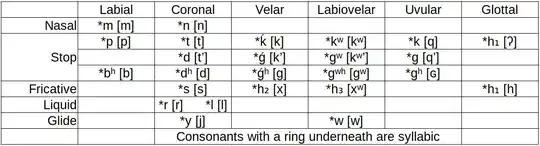
chart of phonemes

But it must be emphasized that this is only a guess: an educated guess, sure, but there's just not enough evidence to call it a "theory", and given the lack of evidence, it's not really falsifiable. Other linguists here can probably give you a dozen other reconstructions that differ from mine. That said—while this guess isn't better than any other, it's also not really worse than any other. So depending on your purposes, that might be enough.

Draconis
  • 65,972
  • 3
  • 141
  • 215
  • This is going off-topic. I like it, but I also perceive it as flame bait. That said, I started to think recently that reconstructed phonemes don't present phonemes very well, the same way the glottal stop is not phonemic in English (glass-'-pear vs glass-spear), if you will, although it's phonologically evident. So stuff like voicing may be phonetically conditioned not as part of the lexeme. Alas, I have no competing theory to offer. – vectory May 19 '19 at 19:05
  • The trace left in the daughter languages is then that of the lexemes most used environment. – vectory May 19 '19 at 19:07
  • 2
    @vectory I'd say the reconstruction does show what phonemes there are…but as you say, it misses out on the hundreds of phonetic details every language has, like the English glottal stop. Which is why, alas, we can never really have any sort of "accurate" Proto-Indo-European pronunciation. – Draconis May 19 '19 at 19:10
  • 1
    (That said, why do you say it's off-topic? OP asked for PIE words in IPA, and I'm explaining why they can't find that anywhere—there's simply not enough info available to do more than guess at the actual pronunciation.) – Draconis May 19 '19 at 19:10
  • I'm pretty sure that IPA pronounciation for PIE is still debated. But i'm looking for any resource that can show IPA pronounciation for each PIE word. Either with laryngeals or without laryngeals. – Rock May 19 '19 at 19:19
  • 3
    @Rock Unfortunately, to my knowledge, such a resource does not exist (because the actual pronunciation is still unknown). – Draconis May 19 '19 at 19:38
  • But Wikitionary gives me small list. So Wikitionary is like small resource. – Rock May 19 '19 at 19:44
  • 4
    @Rock Wiktionary is making a guess (or, rather, Ringe (2006) is making a guess), but it's still no better than guessing. I'm not sure why those particular pages have phonetics given, but imo it's a mistake to list guessed phonetics alongside the far more solid information like the declension table. – Draconis May 19 '19 at 20:04
  • 4
    Wiktionary as well as this answer are trying "to scratch an itch", but of course any dilligent guardian will tell that scratching may worsen the symptoms. – vectory May 19 '19 at 20:24
  • @Drraconis, I'm arriving to late, but I know, that PIE is guess, but very please, find any PIE IPA resource, even pure guess resource, because I want to know, how can I read it. For example, if I don't know, how to pronounce *tréyes, i can read it as /treies/, /trejes/, or even /tre.es/ – Rock May 23 '19 at 17:27
  • @Rock I provided a guess in my answer. If you like that particular guess, it would be /tré.jes/, but if you don't like it, there are dozens of others out there to choose from. – Draconis May 23 '19 at 17:28
  • This is just our guess. Please find any PIE IPA resource, not just your guess. We write something we can read later. – Rock May 23 '19 at 17:30
  • @Rock You just said you were looking for "even pure guess resource". Wiktionary doesn't have any better of a guess than mine (and I'd personally say theirs is worse since it doesn't account for the missing /b/ problem, but that's a matter of opinion). – Draconis May 23 '19 at 17:32
  • Does not matter, which guess is best, I am just looking for any PIE IPA resource, even if guess from this resource is even weirder than your own. – Rock May 23 '19 at 17:34
  • @Rock I can't tell what you're asking for at this point. You said you were fine with a guess, I provided a guess, now you want "not just [my] guess". – Draconis May 23 '19 at 18:05
  • The orriginal question is about finding PIE IPA resources, not from some StackExchange user. Your own guess doesn't help me, because you pronounce PIE words too much phonetically (like me), you pronounce *k as /q/, and Wikitionary resource is too small. Except you, I don't know any person that pronounces *k as /q/. The pronounciation of PIE stops is much more clear than other phonemes. – Rock May 23 '19 at 18:20