Phonetically, I would say no.
Here's a plot of this final vowel (taken from about 12.75 seconds into the linked video). It's not a great plot, since the recording quality I'm using isn't great, but it'll work for our purposes.
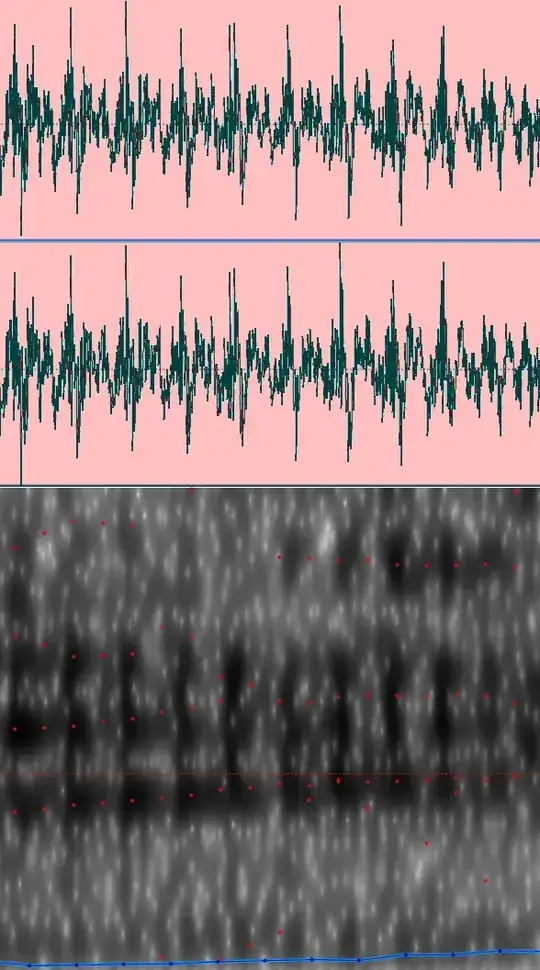
Acoustically, vowels are determined by values called formants, which appear as horizontal black bars in the spectrum. The red dots also represent the formants, just calculated in a different way.
Well, the positions of these formants are continuous: they can show up at any frequency (within a certain range), not only certain specific values. Which means that the space of vowels is also continuous! When someone pronounces a diphthong, they glide seamlessly from one vowel to another—so a diphthong like [æi] starts at [æ] and passes seamlessly through [e] before arriving at [i]. In fact, since frequency space is continuous, it passes through an infinite number of different intermediate vowels!
Clearly, calling all vowel sequences "infinity-phthongs" isn't very useful, even though there are indeed an infinite number of intermediate points. So instead, phoneticists generally ignore everything in the middle, and only pay attention to the critical points—the start, the end, and anywhere the trajectory changes direction.
For example, a sequence like [æɛeɪi] would still be called a "diphthong", since it never changes direction: it moves in a "straight line" from [æ] to [i], and we don't really care about the intermediate stuff. If you connect the dots on an IPA vowel chart, you'll get basically a straight line. So we only care about two phthongs.
But a sequence like [ɑɔoʊuʉy] would be called a "triphthong", because it changes direction once (try connecting the dots on an IPA vowel chart again and you'll see). So we care about the two endpoints, plus the one direction change in the middle, giving us three phthongs.
In this case, there's no real change in direction—the formants are basically straight lines, without any bends or kinks in them. The sound starts somewhere around [ɛ] and moves straight to [i]. It definitely passes through other vowels on the way, but phonetically, that's just how diphthongs tend to work.
P.S. Phonemically, the question is totally different—but I'd also say no. There's no evidence that there are three separate phonemes at the end there; instead, it seems to be an allophone of plain old /i/.
P.P.S. This plot was generated with a program called Praat, which is free to download and play around with if you want to do some phonetic experimentation!
P.P.P.S. "Phthong" is not actually a technical term in linguistics. It's just more fun to say than "critical point in the vowel trajectory".


/j/is the first sound in the English word "yes", while IPA/y/is the first sound in the German word über, or the last sound in the French word tu. – Draconis Aug 14 '19 at 16:37