7

offero

From ob ("towards") + ferō ("bear, carry")

aufero

From ab ("from") + ferō ("bear, carry")

Both prefixes of them end with "-b-", but why do their compounds differ from each other, namely "-b-" vs "-u-"? Is this a regular sound change?

Another question is L "ostendo",

ostendo

From obs- for ob ("before") + tendō ("I stretch").

obtineo

From ob + teneō ("hold; restrain").

Finally, L "obs-" turned into L "os-" in "ostendo", while "ob-" survived in "obtineo", is that also a regular sound change? Can anyone show me some other examples?

hippietrail
  • 14,687
  • 7
  • 61
  • 146
archenoo
  • 1,717
  • 11
  • 21
  • 2
    Obstineo is also possible (think obstinacy), so I think different transformations happened depending on what period the prefigation happened in. As to aufero, that is probably mainly to avoid confusion with affero, from ad-fero, contrastive dissimulation or whatever it's called. I can't think of any other example where ab- becomes au-. Nor obs- => os-: I think that one is just irregular, possibly dialectical, I don't know. – Cerberus Mar 20 '13 at 03:18
  • Oh, there is aufugio. And affugio doesn't exist, so it's probably not because of contrast. Perhaps by analogy, from aufero? Either way, au- for a(b(s))- is not regular. // I can't find any other example of a verb with os-. So os- for obs- is not regular, but then not everything is regular in Latin. Think of compounds with manus, like mancipium... – Cerberus Mar 20 '13 at 03:25
  • It's best to not tack on additional questions to your main question. You should ask one thing. Your main question is also not entirely clear. You wonder if "this" is a regular sound change - but what does "this" refer to? – Sverre Mar 21 '13 at 14:45
  • @Sverre, Thanks for your advice, in the main question, "this" refers to the change from "ab-" > "au-" – archenoo Mar 21 '13 at 16:28

1 Answers1

14

In Latin, there was total regressive assimilation in a combination of an occlusive (Verschlusslaut) followed by f:

OCC+f> -ff-

Examples:

affero < *at-fero < *ad-fero (recomposition also possible - adfero)

offero < *op-fero (recomposition also possible - obfero)

effero < ec-fero (recomposition also possible - ecfero)

cf. Weiss 2009/2011: 172, "Latin does not normally have f in non-initial positions. The few examples are in compounds and the family of inferus."

Also note that the group "bt" in Latin was most likely pronounced [pt] (Tronskii 1960: 114). Prefixes ab-, ob-, and sub- are usually reconstructed as PIt. *ap-, *op-, and *sup- (Tronskii 1960: 113, de Vaan 2008).

As for aufero (and aufugio), here's what you can find in de Vaan 2008:
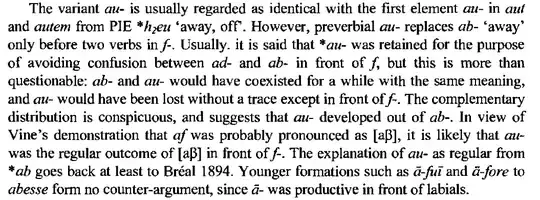
deVaan2008

In a combination of a labial/velar followed by s+C, the first consonant (labial or velar) was lost:

ostendo < *ops-tendo

suscipio < *sups-capio

suspicio < *sub-specio etc.

cf. Leumann 1977 "Neben ab ob sub stehen die mit s erweiterten Formen abs- obs- subs- bzw. aps- ops- sups-, fast nur als Praeverbien [...] Die s-Formen stehen nur vor Tenues, besonders in altertuemlichen Komposita; oefters sind sie vereinfacht zu os- sus-, vor p auch as- [...]" (p. 157).

Ernout & Meillet 1985/2001, "ce dernier [obs-; Alex B.] usité seulement en composition; [..] il est souvent réduit à os-" (p. 454).

So, as you can see (Ernout & Meillet 1985/2001, Leumann 1997), the form obs- was usually used in compounds.

References:

Ernout, Alfred, Antoine Meillet, and Jacques André. 2001. Dictionnaire étymologique de la langue latine: Histoire des mots. Paris: Klincksieck.

Leumann 1977, § 203. - Leumann, Manu, J. B. Hofmann, Anton Szantyr, and Friedrich Stolz. 1977. Lateinische Grammatik: Lateinische Laut- und Formenlehre. München: Beck.

Pfister 1977, §137.2. - Pfister, Raimund. 1977. Handbuch der lateinischen Laut- und Formenlehre. Band 1, Einleitung und Lautlehre. Heidelberg: Winter.

Tronskii 1960, §232, 268. - Tronskiĭ, I. M. 1960. Istoricheskai︠a︡ grammatika latinskogo i︠a︡zyka. Moskva: Izd-vo lit-ry na inostrannykh i︠a︡zykakh.

Vaan, Michiel Arnoud Cor de. 2008. Etymological dictionary of Latin and the other Italic languages. Leiden: Brill.

Weiss, Michael L. 2011. Outline of the historical and comparative grammar of Latin. Ann Arbor: Beech Stave Press.

Alex B.
  • 8,744
  • 2
  • 25
  • 42
  • 1
    Epic answer! And thank you so much!!! May I ask you the origin of L "ecfero"? Maybe it derives from ex- + fero, but why does the "x" change to "c"? – archenoo Mar 21 '13 at 16:34
  • Alex, fantastic answer! @archenoo: In many words, ec- is from Greek: ecloga, ecclesia, ecdicus, etc. Because pherô means the same thing in Greek, it is possible that Latin somehow borrowed this from Greek (also possible for ecfatus), but I doubt it. There is probably some Proto-Latin sound change at work. – Cerberus May 09 '13 at 05:54
  • @ewawe re: suspicio < *sups-capio. Sorry, I meant to write suscipio - it was a typo, I fixed that. – Alex B. Apr 03 '20 at 15:02
  • @ewawe re: a velar being lost before sC: this is a well-known sound change, see e.g. Weiss 2020, page 197, rule D5. *TsT > -sT- (T stands for tenues). There are two exceptions listed in Tronskii 1960 (paragraph 268): cst is preserved or restored in formal (literary) Latin after a short vowel, cf. dexter vs. lustrum or Sextus vs. Sestius. – Alex B. Apr 03 '20 at 15:19
  • 1
    @AlexB.: Thanks, I didn't think about the possible role of vowel length in affecting this change – brass tacks Apr 03 '20 at 19:17