I am looking for languages with writing systems that are almost completely ideally phonemic (i.e. no silent letters and an unambiguous one-to-one correspondence between the letters and the phonemes). Two that I have found so far are Swahili and Esperanto. Does anyone know of more? It would be great to compile as many as possible.
Asked
Active
Viewed 587 times
2


-
Most recently-developed orthographies are phonemic, having a one-to-one correspondence between graphemes and phonemes. So it may well be the case that the majority of orthographies on earth are truly phonemic. – Gaston Ümlaut Oct 11 '13 at 23:42
-
They don't always stay as phonetic as when they were developed. I believe the Canadian syllabary took off but changed for either Cree or a language in Nunavit. I don't have details at hand though sorry. – hippietrail Oct 12 '13 at 10:07
-
1Since you include Esperanto, you probably could include practically all constructed languages, including lojban, Klingon, Na'vi, etc. The list will be endless because as soon as you complete it, someone could invent another language, on the spot, making your list incomplete. – prash Oct 12 '13 at 19:11
3 Answers
0
Most recently developed orthographies are phonemically straight forward - they become less ideal as time goes on and the spoken language goes under sound shifts, but the written language doesn't.
Most of the languages SIL has worked with did not have an orthography before, so you'll be able to find many in their archive.

curiousdannii
- 6,193
- 5
- 26
- 48
-
But how many of those languages they've developed orthographies for have gone on to achieve high literacy among their communities? – hippietrail Oct 12 '13 at 10:05
-
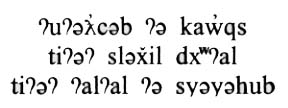
Most of them have gone on to become extinct. An example is Lushootseed, which is at best moribund, but which has a very nice and quite phonemic orthography. Here's an inscription in Lushootseed in the new wing of the University of Washington Library, and some grammatical puzzles in Lushootseed. – jlawler Oct 12 '13 at 15:04
-
@jlawler 'most of them have gone on to become extinct'?? That may be true in some areas (eg North America and Australia), but not yet in the rest of the world. – Gaston Ümlaut Oct 12 '13 at 22:19
-
@hippietrail My experience is that with a shallow orthography it's quite easy to develop a good level of literacy. Even so, it's a bit unfair to think it should happen in short order -- English took centuries after first being written to develop much of a literature, and high literacy is recent. – Gaston Ümlaut Oct 12 '13 at 22:24
-
1Cherokee had a pretty phonemic orthography -- Sequoiah's syllabary -- and got near 100% literacy very fast. Of course this was before the First Nations were sent to concentration camps and they had freedoms just like Americans. – jlawler Oct 12 '13 at 23:07
-
I'm not picking on anything here. It just doesn't seem to right to claim an orthography has been successful in being phonemic if it hasn't caught on in the community. Even though the reasons for it not catching on is more due to things such as poverty, discrimination, lack of education, the community's assimilation to the dominant culture and/or language, etc. – hippietrail Oct 13 '13 at 10:00
-
Vietnamese quốc ngữ is the most successful orthography developed by missionaries I can think of. But it's not that phonemic because the dialect differences in Vietnam were taken into account. A recent success story is the Latin alphabet used for Hmong but I don't know whether missionaries were behind it. In Mexico and Central America many many native languages have orthographies but even in places where the locals were doing quite well and used their language for everything, the people I talked with did not know the writing. Canadian syllabics also seems successful but was it by missionaries? – hippietrail Oct 13 '13 at 10:31
-
1@hippietrail While there are certainly examples where communities have made little use of the orthography developed for their language, I can think of many cases where communities do indeed use their recently-developed orthography. They may not be writing novels, but it's used in education, in community notices, letter-writing, song writing etc. I guess the regions I have in mind are Australia, PNG, the Pacific and south-east Asia. – Gaston Ümlaut Oct 13 '13 at 21:09
-
@hippietrail, well you didn't ask specifically for successful orthographies... Even if not much is written in the language, if its used for the first few years of schooling it will help hugely. Learning to read and write your vernacular is very beneficial, compared to learning to read and write a language which you hardly know. Even if the students quickly shift to another language, a couple years reading their own language will be of immense benefit. – curiousdannii Oct 16 '13 at 02:36
-
Sorry curiousdannii it wasn't me who asked but @Daudi. I do think it's a good thing to invent orthographies for oral languages and it's a shame the Tz'utujil and Garifuna and Zapotec mostly don't write their languages. I just wanted Daudi to see that there's probably a long list of phonetic writing systems that are largely "theoretical" because they're not used. In fact I bet there's more than a couple of phonetic writing systems for English that people have invented that are not used either. So the wording ideally is actually very accurate but we don't know why Daudi wanted this list. – hippietrail Oct 16 '13 at 03:28
0
Armenian is one of such languages. More, it is one of the oldest languages known to be mostly phonemic.
Quoting from here:
In the late 4th century AD, king Vramshapuh of Armenia asked Mesrop Mashtots, one of the officials in his chancellery and a prominent scholar, to create a new alphabet for Armenian.
Mashtots travelled to Alexandria, where he studied the principles of writing and came to the conclusion that the Greek alphabet was the best alphabet in use at that time because there was an almost one-to-one correspondence between sounds and letters. He used this model to come up with a new alphabet, which he presented to the king when he returned to Armenia in 405 AD. The new alphabet was well-received and a new Armenian translation of the bible was published in 405 AD. Other literary works soon followed.
There are some differences between spoken and written language:
- Two sounds,
[f]and palatalized[ja]that have been adopted from Russian. - Other subtle differences have primarily dialectic nature.


Be Brave Be Like Ukraine
- 8,629
- 9
- 38
- 66
-
2One problem with an interesting solution in the case of Armenian is that the two major dialects, Eastern (in Armenia) and Western (in the diaspora) each utilize slightly different spelling as they try to reflect their different pronunciations. I believe Western Armenian might also have not adopted some of the reforms to Armenian orthography that were brought about during Soviet times. – hippietrail Oct 13 '13 at 10:49
-
@bytebuster Armenian is not a good example since it has at least one digraph, i.e. in at least one case a sequence of two letters correspond to just one phoneme, namely /u/ spelled ‹ou›. This makes the Armenian script something less than a perfectly phonemic alphabet. – Artemij Keidan Apr 02 '17 at 10:11
-1
This is pretty much the case with Turkish.

fdb
- 24,134
- 1
- 35
- 70
-
2
-
1Turkish still retains a few quirks such as the "silent" ğ that lengthens the previous vowel, and it has a circumflex accent to indicate long vowels which is seldom used now and mainly I believe for some surviving words of Arabic and Persian origin - but also for a separate native Turkish quirk I now can't recall the details of. – hippietrail Oct 12 '13 at 10:10
-
-
The different realisations of ğ is a phonetic issue, not a phonological one. The positing of a single phoneme /ğ/ is certainly a sustainable analysis. â does not designate a long vowel (at least not in a Turkish context), but indicates the palatalisation of the preceding consonant. – fdb Oct 12 '13 at 20:07
-
@fdb: SigueSigueBen's answer to a previous question here has some info on the circumflex and long vowels in Turkish: *In Turkish, how exactly does “ğ” affect the vowel it follows?* – hippietrail Oct 13 '13 at 10:42
-
There's also the palatalization issue that affects /k/ /g/ and /l/: "sol" means left when pronounced with a velarized /l/ and musical note G when pronounced with a palatalized /l/. – cyco130 Nov 05 '13 at 17:14