In English and other languages there are three degrees of comparison: positive, comparative and superlative (e.g. tall, taller, tallest). Are there languages with more than three degrees, expressed morphologically?
Asked
Active
Viewed 2,083 times
8


-
1Hmm so how do you envision such a fourth degree? "Tallest of three"? – Cerberus Jun 12 '12 at 17:07
-
4There is elative (meaning: very) and its opposite - attenuative (meaning: a bit, somewhat, rather). They are different kinds of intensification, however there is no comparison (they are absolutes). So they're not really degrees of comparison. – Alex B. Jun 12 '12 at 17:28
-
3@Cerberus I can envision a degree for "the least tall of all" – Otavio Macedo Jun 12 '12 at 18:00
-
At least a lot of old grammar books treat the *absolute superlative* along with the other degrees of comparison. So it could come down to a semantics vs tradition debate or some other distinction. – hippietrail Jun 12 '12 at 18:26
-
By the way, if these absolute forms are not degrees of comparison, neither can tall be, since it's not comparing with anything. However as tall as is comparing with something but at least in English it's a formula rather than an inflection - I wonder if there are languages which treat it morphologically though? – hippietrail Jun 12 '12 at 18:28
-
1I seem to recall that Hungarian has an extra degree ("excessive"). According to German Wikipedia, Basque has it as well. In English, one would use too + positive. I don't have any handy sources, but maybe someone with more background can help out? – Ansgar Esztermann Jun 12 '12 at 20:32
-
1Some keywords for further research:"scalar inequality", "scalar superiority", and "scalar inferiority". Hippietrail is talking about "equative". – Alex B. Jun 12 '12 at 23:50
-
@OtavioMacedo: Hmm...I suppose that would be a degree of comparison, if such a (non-analytic) degree existed in a given language... – Cerberus Jun 13 '12 at 00:19
-
3@OtavioMacedo "talleast" – acattle Jun 13 '12 at 02:25
-
1@AnsgarEsztermann: Yes that is what is termed the *absolute superlative* I mentioned above. It's sometimes equated with English too and many languages have it, including most Romance languages, for example the -ísimo ending in Spanish. – hippietrail Jun 13 '12 at 06:52
-
2http://linguistics.stackexchange.com/questions/1376/does-any-language-use-bound-morphology-to-express-the-concept-less – Alex B. Jun 13 '12 at 22:32
-
1also see Stassen 2001 http://www.degruyter.com/view/books/9783110171549.2/9783110171549.2.10.993/9783110171549.2.10.993.xml?format=EBOK – Alex B. Jun 13 '12 at 23:31
-
2@hippietrail: Welsh has a distinct equative. In fact, I'm going to make that an answer. – Colin Fine Jun 14 '12 at 23:16
2 Answers
8
At first, some general remarks on comparison and terminology. My answer is mostly based on Pierluigi Cuzzolin's research.
Let's start with some definition of comparison. Cuzzolin and Lehmann 2004 give the following definition:
"Taken as a grammatical category, comparison (German Steigerung) is the formal modification of some predicative word – most often an adjective – representing a parameter of gradation or comparison, according to the extent to which it applies to its argument, relative to some standard" (p. 1212).
Thus, comparison as a grammatical category includes "semantic" comparison (relative) and gradation (absolute).
Any comparison must contain at least the following three elements: the comparee, the parameter (a cognitively salient feature), and the parameter marker (a morpheme expressing a degree).
Secondly, Heine has a nice table on types of comparison. Naturally, there is some variation in terminology - but this is irrelevant here.
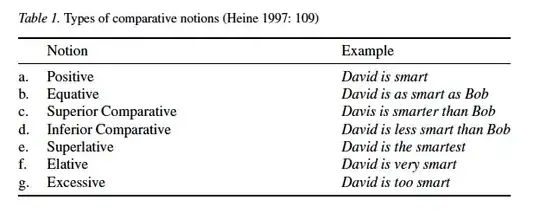
Cuzzolin and Lehmann 2004 argue that traditionally three degrees of comparison are recognized:
- the positive degree;
- the comparative degree, which can involve comparison of majority (smarter), comparison of minority (less smart), comparison of equality (as smart as), and even sameness (known as similative);
- the superlative degree.
Although comparison usually occurs on adjectives and adverbs, it can occur on other parts of speech, too:
Italian canzonissima 'the best song'
Basque gizonago 'more man'
The most important thing to remember about comparison is that it can be expressed by different means: morphologically, syntactically (for examples see Cuzzolin and Lehmann 2004).
Now about equative expressed morphologically (like in Welsh). Cuzzolin and Lehmann argue that it's not that common. They mention the following language groups and languages: Celtic languages, Finno-Ugric languages, Kartvelian languages, Tagalog, Indonesian, Greenlandic Eskimo, and Estonian. An example from Estonian is below:


Alex B.
- 8,744
- 2
- 25
- 42
-
Tagalog example: "Singtangkad ko ang kapatid kong babae." The prefix "sing-" means "as ... as". tangkad - tall, ko - me or my, kapatid na babae - sister. Superlative "tallest" is "pinakamatangkad". Elative "very tall" is "napakatangkad". – Noble_Bright_Life Nov 21 '19 at 05:21
-
Why, I wonder, does Heine separate superior and inferior comparatives, but not superior and inferior superlatives (‘David is the smartest’ vs ‘David is the least smart’)? And why no inferior elatives and excessives (‘David is very little smart/hardly smart at all’ and ‘David is not smart enough’)? – Janus Bahs Jacquet Jul 23 '21 at 14:28
-
@JanusBahsJacquet valid points. I have to look it up again, it's been five years since I read it last time. – Alex B. Jul 23 '21 at 15:17
4
Welsh has a distinct equative, as well as the comparative and superlative.
From the article linked to: teg "fair", teced "as/so fair", tecach "fairer", tecaf "fairest".
So mor teced â = "as fair as".

Colin Fine
- 7,454
- 22
- 28
-
4This seems to be exactly what the OP is looking for! Could you explain what a distinct equative is and provide some examples? Maybe with interlinear glosses and all that cool linguistic stuff ;-) – Otavio Macedo Jun 15 '12 at 00:42